The Altarpiece
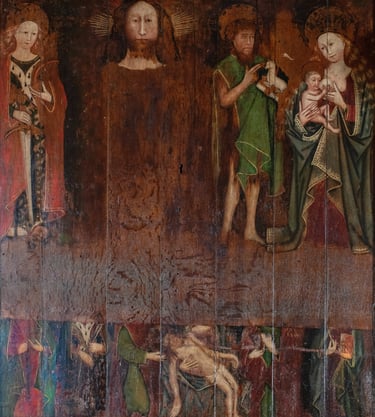
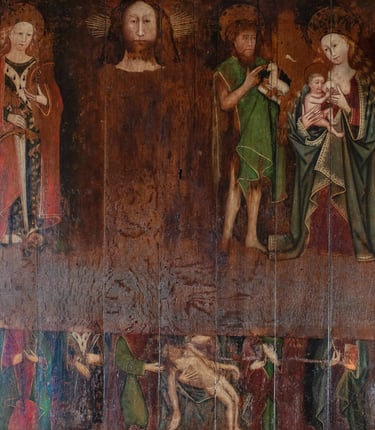
The face of Christ looks passively out from this damaged but still impressive artwork. Time or human agency has worn or scrubbed away the entire centre of the painting down to the bare oak boards, but a brilliant reconstruction by David MacRoberts* has seen it reinstated as the original altarpiece.
What remains shows the large head of Christ flanked by the figures of St. Catherine to the left and John the Baptist and the Virgin Mary on the right. The Virgin, unusually, is suckling her child. St John holds the Lamb of God and raises his right hand in blessing, while St Catherine clutches the wheel on which she was martyred; at her feet, impaled by her sword, lies the head of a tyrant – she was a feisty lady! The painting is unbalanced: since Christ would undoubtedly have been in the centre, there must have been a further figure on the left side, at least.
Beneath the main image and on a smaller scale is a different scene, the Deposition from the Cross, originally isolated by a painted or moulded border. Mary the Mother tenderly cradles the body of her son; looking on are a number of supporters: evangelists (identified by their books), Mary Magdalene with a pot of unguent, and a figure (possibly St. Apollonia) holding the pliers used to extract the nails from Christ’s hands and feet. The heads are missing (is there a connection here with the headless figures on the font?) and Christ’s face has been disfigured with a toothed implement - suspiciously like reformers’ work despite the 7th Lord Gray’s efforts to preserve the church from iconoclasts.
MacRoberts based his reconstruction on the description of the now lost altarpiece at Arbroath Abbey. This showed Christ as Salvator Mundi, ‘Saviour of the World’, with the orb in his hand - a motif already familiar in Fowlis Church and which, if he was seated, would fit neatly into the blank space in the middle of the painting. For the portraits of the abbey’s patron saint, Thomas a Becket, and founder, King William the Lion, MacRoberts substituted St. Marnock and Andrew Lord Gray and his wife. He postulates that those of the founding couple, being family, may well have been removed for safe keeping. Ironically these are now lost.
Set into a rich and elaborate frame and lit up by the SE window, this painting in its full glory would have made a splendid backdrop to the ceremonies at the altar, set off by the gleam of liturgical vessels, flickering candles, jewelled and embroidered altar-cloths and the colourful vestments of the officiating clergy. It deserves our deep respect.
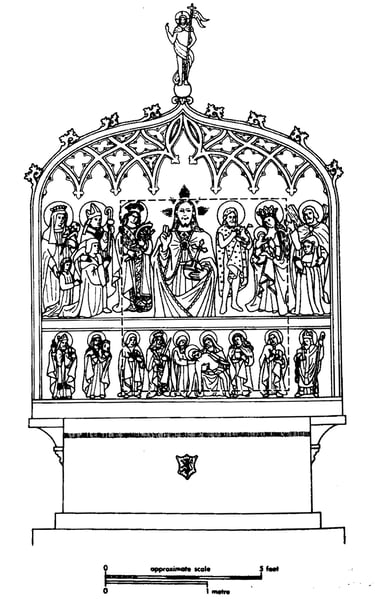
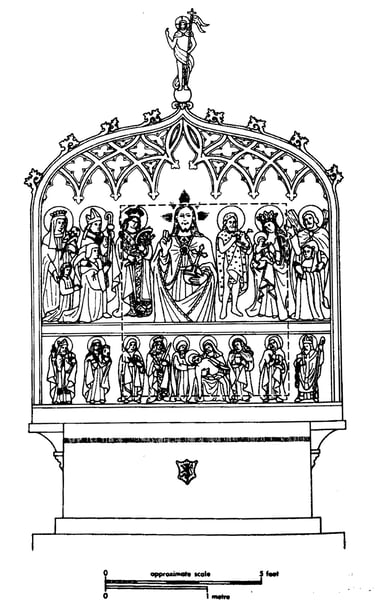
*David McRoberts: The 15th c Altarpiece in Fowlis Easter Church
(ed.) Anne O’Conner and DV Clarke From the Stone Age to the ’45 (Essays presented to RBK Stevenson) Edinburgh 1983 pp384-98
Contact
Get in touch for questions
stmarnocksfowlis@gmail.com
© 2025. All rights reserved.
Scottish Charity
Friends of St Marnock's
SC054653