The Crucifixion
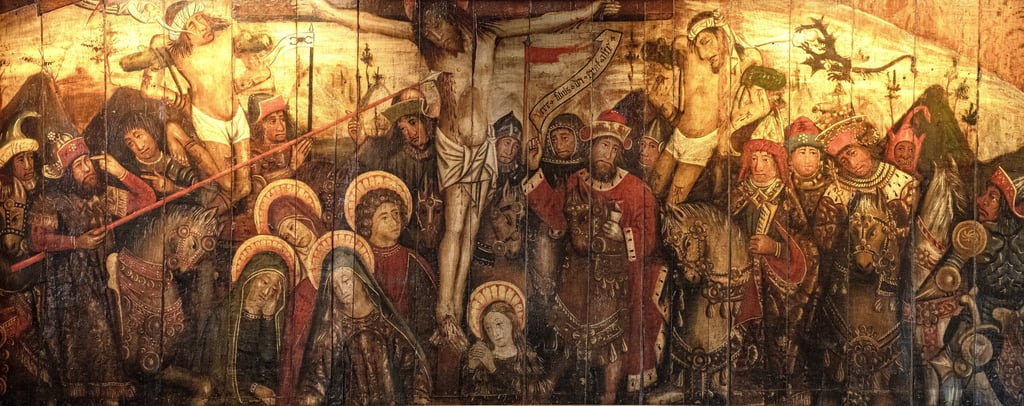
This magnificent painting once filled the space above the rood loft, proclaiming the message of the crucifixion to the congregation below. It has been hailed as a unique survivor, evidence of the wealth of decoration and didactic imagery prevalent in every pre-Reformation church – as well as a reminder of what has been lost. So full is it of life and incident, however, and so intriguing in the way that it straddles the transition from the late Middle Ages to the early Renaissance, that one wonders how unusual, if not exceptional, it was even in its own time.
It has been called many other things too: medieval; a Flemish import; Italian-influenced; a product of the cultured court of 15th c Scotland; early Renaissance; crudely painted; a masterpiece of ‘rustic vigour’; a conversion narrative and a sermon in paint for the unlettered classes.
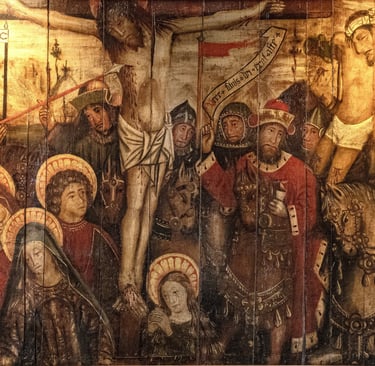
First and foremost, the painting fulfils the role on the rood loft usually undertaken by the cross, the proud symbol of Christianity. But more than that, it tasks itself to tell the whole Crucifixion story, even incorporating characters who are not mentioned in the Biblical narrative. In the centre where the cross should be, Christ hangs at the point of death. At its foot are the five faithful friends: the swooning Mother and her attendant women, John looking tearfully upwards, Mary Magdalene praying by the blood-stained feet. On either side of Christ are the two thieves, their arms draped over ‘tau’ crosses made from living wood and in the act of giving up their souls. The soul of the penitent thief on Christ’s right hand is retrieved by an angel, while the other’s – bound for Hell – is being carried off by a fearsome dragon. Around and about throngs a dense cast of characters - officials, soldiers and attendants, both on foot and on horseback. Who are they?
To the left: blind Longinus, his spear, guided by an onlooker, piercing the side of Christ. He is pointing to his eye because Christ’s blood has spurted into it and his blindness is immediately cured. On the right: the Centurion; his ‘speech scroll’ (the medieval equivalent of a speech bubble) proclaiming “Truly this was the Son of God.” Beyond him: the high priest clutching the arrest warrant, with a red nose and a very smug expression (this artist is not without a sense of humour – or perhaps a strong sense of justice). Next, with an ermine cape and extraordinary headdress, is Herod. The Bible does not mention Herod as being present at the Crucifixion but here he is, looking crestfallen, penitent even. The reaction of the figure on the extreme right could hardly be more different: he fixes the dying Christ with an utterly contemptuous glare. In the general melee are Roman soldiers, characters in ‘Turkish’ helmets (the Turks never wore them but it sounds exotic) and horses done up in equally elaborate harness, which is loosely based on genuine Roman models with the addition of ‘tear drop’ decorations. Behind this busy scene is a sketched-in landscape of trees and hills, which if anything looks more Italian than Flemish.
One figure who is unique to this painting is the jester, the ‘Fool of Fowlis’, who peers over Herod’s shoulder in his red hood and ass’s ears. His presence at the Crucifixion has given rise to much speculation. He could, of course, simply be a companion of the king, but given the tendency of mediaeval religious art to carry a message, it seems likely that the jester has something to tell us.
Michael Bath* takes the jester as the clue to the painting’s function as a ‘conversion narrative’. He notes that the fool is the only character in the painting who is looking directly at us, the viewers, and ties this in with Psalm 14: ‘the fool hath said in his heart, there is no God.’ Taken in conjunction with Longinus, the Centurion, Herod and the penitent thief, a good case can be made for interpreting the painting as an exhortation to the congregation not to be fools but to look at Christ on the cross and join the ranks of believers.
Scotland in the 15th century had a thriving relationship, both economic and cultural, with North Germany and the Low Countries. The finest art - by the likes of van Eyck - was imported by those who could afford it, and must have influenced the work of local artists, of whom a small number are recorded by name if not by surviving output. The Crucifixion painting, whatever its origins, (and its artist remains unknown), undoubtedly draws on North European tradition for both its inspiration and its cast of characters. The centurion’s speech scroll, to take one example, is identical to that in a 14th century altarpiece from Dortmund in Germany. But further influences can also be seen at work: those of the emerging Italian Renaissance.
Artists in Germany and Flanders were well aware of this too of course, and our artist could have inherited some Italianate features ‘second hand’; the notion of living trees for the thieves’ crosses, for instance, would be an easy thing to pass on. Other Renaissance trends, though, seem at once more nebulous and more deeply rooted. Take the art of composition: if you look, you can see the figure groups in this painting arranged as a series of overlapping triangles, while, in a dramatic a tour de force, the upward thrust of Longinus’s unmissable spear exactly mirrors the furious gaze of the far-right character, the two lines meeting over Christ’s body. Renaissance influence may also be behind the artist’s humanity: in contrast to the bombastic centurion in the Dortmund piece, proclaiming his conversion to all and sundry, his Fowlis counterpart speaks wonderingly to himself, his gaze not on his neighbours, or on us, but lost in infinity.
Could the artist have been Scottish? If he was, it has been pointed out that this would be the earliest example of Scottish figurative painting. Whatever his nationality, the work seems to have been done in situ: the unpainted areas in the top corners suggest that the backing boards were already in place beneath a barrel-vaulted ceiling. Moreover, it’s possible that the same artist was active elsewhere in Angus and left his mark in a burial aisle at Guthrie. This piece (a painted ceiling) can be seen in the Royal Museum of Scotland; only the artist’s under-drawing remains, but it includes an almost identical grouping of the faithful followers at the cross. The inclusion of the arms of James III has allowed this artwork – and by extension possibly the Fowlis one - to be dated to 1472-90. **
The Fowlis painting is truncated: the figures round the foot and sides are incomplete, and as it stands it would not have filled its allotted space. Five detached fragments (now framed together and hung on the south wall) cannot be matched jigsaw puzzle-wise with the main picture and probably come from somewhere on the outer edges. They portray two soldiers, two Moors (whose quite different reactions to what they are witnessing is a further example of the artist’s ability to capture emotion), and, intriguingly, a figure in a tall hat with a red feather. He looks quite unlike any of the others and is very probably the donor. It was not uncommon for the donor to have himself painted into in his picture, usually, as here, in an attitude of piety and supplication to the deity. It is to be hoped that his magnanimity in commissioning this wonderful painting has been well rewarded.
*Michael Bath: ‘A Jester at the Crucifixion? The Fool at Fowlis’ History Scotland Vol.8 No.4 July/Aug 2008 pp14-18
** In connection with the date of the painting, it should be noted that Dalgetty considers the donor’s distinctive hat [see the last paragraph] to be a crucial factor. He dates this, and therefore the painting, to the middle of the 16th century.
Contact
Get in touch for questions
stmarnocksfowlis@gmail.com
© 2025. All rights reserved.
Scottish Charity
Friends of St Marnock's
SC054653